What this agreement includes and why it matters
The agreement has two main components.
First, Nebius will deploy approximately $12 billion in dedicated AI infrastructure for Meta across multiple global locations. These deployments are expected to begin coming online around 2027 and will be among the earliest large-scale implementations of Nvidia’s Rubin architecture.
Second, Meta has committed to purchasing additional capacity from Nebius’s broader AI cloud clusters. That capacity will initially be offered to other customers, but any remaining availability—up to $15 billion—will be allocated to Meta over the five-year term.
The combined commitments bring the agreement to approximately $27 billion, with both dedicated infrastructure and additional capacity reserved over five years.
Why hyperscalers are securing AI infrastructure years ahead
Training and running advanced AI models requires significant compute resources. As models become more complex, infrastructure requirements scale quickly—not only in terms of GPU count, but also networking, power density, and cooling.
For companies like Meta, waiting until infrastructure is available introduces risk. Delays in compute access can slow down model development, product releases, and competitive positioning. Securing capacity early helps reduce that uncertainty.
The agreement reflects a shift toward sourcing AI infrastructure from specialized providers rather than relying solely on internal builds or traditional cloud platforms.
Build a Faster, More Reliable Network with Nuday
Seamless connectivity, low-cost cross-connects, and top-tier carriers.The role of Nvidia’s Rubin platform
The infrastructure supporting this agreement will be based on Nvidia’s Rubin architecture, expected to succeed current GPU platforms such as Hopper and Blackwell.
Rubin systems are designed to deliver higher performance for both AI training and inference. These improvements come from several factors:
- New GPU architectures with increased processing capability
- Higher-bandwidth memory to handle large model workloads
- Advanced interconnect technologies such as NVLink
- High-speed networking using InfiniBand or next-generation Ethernet fabrics
These systems are expected to connect tens of thousands of GPUs into large-scale clusters. As a result, data centers will need to support significantly higher density environments, often exceeding 100 kW per rack.
High-density GPU clusters require changes in cooling systems, power distribution, and network design.
What the Debate Means for the Future of Data Infrastructure
The discussion around orbital data centers highlights how rapidly digital infrastructure is evolving. Satellite constellations are already transforming global connectivity, particularly in remote regions where terrestrial fiber networks are limited.
At the same time, proposals that dramatically expand orbital infrastructure introduce new regulatory, environmental, and operational challenges.
Managing satellite density, ensuring safe orbital traffic, and maintaining sustainable space operations are becoming increasingly important topics as more companies enter the satellite communications market.
For regulators, the challenge is balancing technological experimentation with long-term orbital sustainability.
What this means for data center design
The shift toward AI-driven infrastructure is already influencing how data centers are built and operated.
Several trends are becoming more visible:
- Higher power density: AI clusters require far more power per rack than traditional workloads.
- Advanced cooling requirements: Liquid cooling and optimized airflow strategies are becoming necessary to manage heat output.
- Network performance as a priority: Low-latency, high-throughput connectivity is critical for distributed AI workloads.
- Scalability planning: Facilities must be designed to expand capacity without disrupting existing operations.
Similar infrastructure requirements are emerging across enterprise and mid-scale AI deployments as workloads increase.
What this signals for colocation and AI infrastructure providers
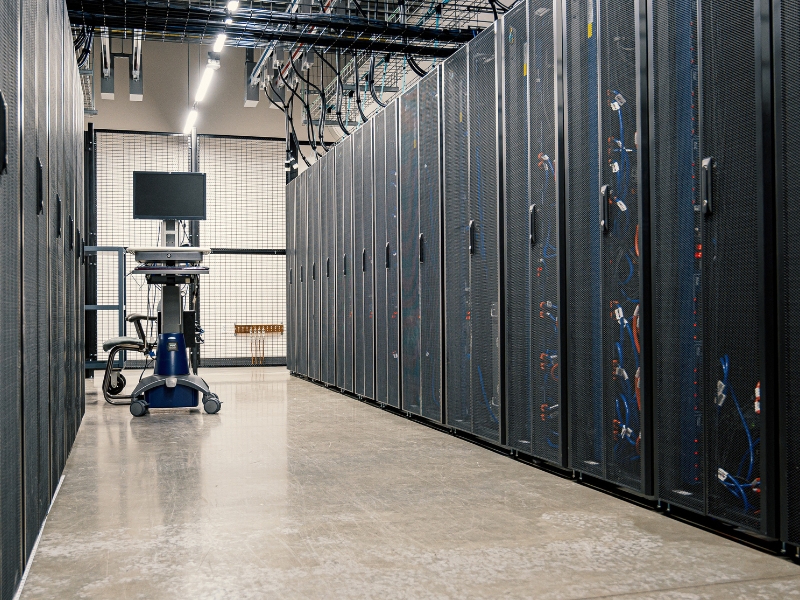
The Meta–Nebius agreement highlights the growing role of specialized infrastructure providers in the AI ecosystem. Instead of building everything internally, large organizations are partnering with providers that can deliver tailored environments for high-performance workloads.
This creates a clear opportunity for colocation data centers that can support:
- High-density deployments
- Flexible power and cooling configurations
- Carrier-neutral connectivity
- Reliable uptime for mission-critical systems
Facilities that meet these requirements are becoming part of the broader AI supply chain.
Design a Network Built for Performance and Redundancy
Carrier-neutral connectivity, direct peering, and predictable latency.How this trend connects to managed colocation
For many organizations, building a dedicated AI-ready facility is not practical. The cost, complexity, and time required can be significant.
Managed colocation provides an alternative. Instead of owning the infrastructure, companies deploy their systems in a facility designed to support high-performance workloads, while benefiting from:
- Scalable power and space allocation
- Redundant connectivity through carrier-neutral networks
- On-site operational support through remote hands services
- Infrastructure designed for reliability and continuity
For example, businesses exploring Managed Colocation Services can align their infrastructure strategy with emerging AI requirements without committing to large capital investments.
Why location and network design still matter
Even as AI infrastructure scales globally, location remains a key factor.
Data centers in regions like Markham and the Greater Toronto Area offer advantages such as:
- Access to major network exchanges and direct peering
- Lower latency for regional users and services
- Climate conditions that can support more efficient cooling strategies
A Carrier-Neutral Network Infrastructure also plays a critical role. Direct connectivity to multiple providers improves resilience and performance, especially for distributed AI workloads that rely on continuous data exchange.
Operational support and continuity planning
As infrastructure becomes more complex, operational support becomes more important.
Organizations running AI workloads often require:
- Rapid response to hardware or network issues
- On-site technical support for deployments and maintenance
- Structured disaster recovery planning
Services such as Remote Hands and On-Site Support Services and Disaster Recovery and Business Continuity Solutions help ensure systems remain available even as workloads scale.
Securing future capacity is becoming standard practice
The Meta–Nebius agreement reflects a broader pattern. Companies are no longer treating infrastructure as something they scale reactively. Instead, they are planning years ahead and securing capacity before demand peaks.
This approach provides two key advantages:
- Predictability in infrastructure availability
- The ability to support long-term AI development without interruption
For infrastructure providers, long-term agreements also create stability. They justify the investment required to build next-generation facilities capable of supporting high-density AI environments.
Key takeaways for IT decision-makers
- AI infrastructure demand is increasing faster than supply, especially for next-generation GPU platforms.
- Hyperscalers are committing to compute capacity years in advance to avoid future constraints.
- Data center design is evolving toward higher density, advanced cooling, and stronger network performance.
- Colocation providers are becoming critical partners in delivering scalable AI infrastructure.
- Planning infrastructure early can reduce risk and support long-term growth.
Final perspective
The Meta–Nebius deal is less about a single partnership and more about a shift in how infrastructure is approached in the AI era. Capacity is no longer something organizations wait to acquire—it is something they secure early to stay competitive.
For companies evaluating their own infrastructure strategy, the direction is clear. Preparing for future workloads now will influence how effectively systems can scale later.
Related Insights from Nuday:
- Introducing Nuday’s Secondary Network: Affordable Redundancy for Critical Infrastructure
- Nuday Marks 10 Years of 100% Uptime and Industry-Leading Performance
- Cooling Efficiency Upgraded: How Blank Filler Panels Are Making Our Data Center Cooler and Smarter
- Supporting a Greener Environment Through Sustainable Operations
- Nuday Networks and Fortinet Announce Exciting New Partnership in Network Security