
Quarter rack colocation can fit businesses that need more room than single-server hosting but do not require a half or full rack. The right size depends on more than server count. Current equipment, power demand, network hardware, expected growth, and access or support needs all affect the decision.

How Is Colocation Rack Space Measured?
U-space measures height, not total server capacity. A rack may also contain switches, firewalls, storage appliances, backup hardware, and power-distribution equipment. Some devices require several rack units, while others have mounting or depth requirements that affect physical fit.
For more detail on rack units and how colocation rack space is organized, see our related article below.
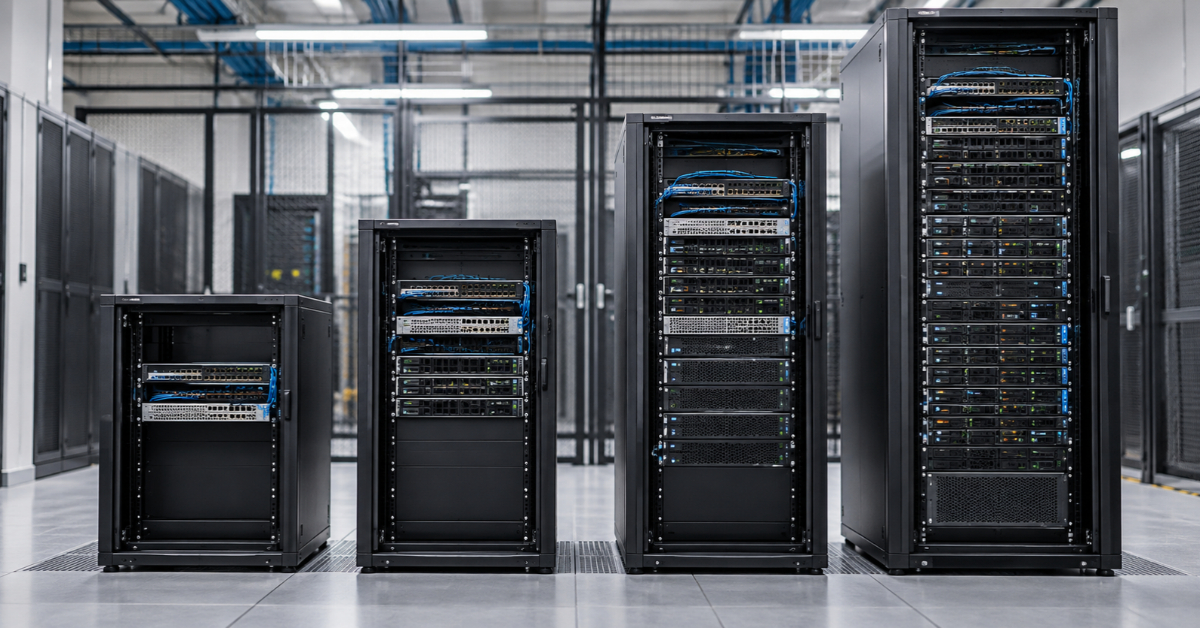
How Do 1U, Quarter Rack, Half Rack and Full Rack Compare?
A 10U quarter rack does not automatically hold ten servers. Ten 1U servers would occupy 10U on paper, but a real installation may also need switches, firewalls, storage, or other rack-mounted hardware. Larger 2U or 4U servers consume the available space faster.
The same principle applies to half rack colocation and full rack colocation. Equipment dimensions, supporting hardware, and power demand determine how much of the rack can actually be used.
When Does Quarter Rack Colocation Make Sense?
A quarter rack may fit several rack-mounted devices, such as servers combined with a firewall, network switch, or storage appliance. It can also provide room for planned additions without immediately moving into a much larger footprint.
For example, four 1U servers occupy 4U, but the complete deployment may require more space once network and storage equipment are included. Hardware planned for the next upgrade cycle should also be considered before settling on the current footprint.
A quarter rack can also suit a business that wants its related server and network equipment kept together in a dedicated cabinet section, provided both the current load and planned growth fit the 10U footprint.
Businesses considering this size can review Nuday’s Quarter Rack (10U) colocation after documenting their equipment and power requirements.
When Should You Move to a Half Rack or Full Rack?
Quarter rack space can become restrictive as the environment grows. The next size should reflect planned equipment, power requirements, and how quickly expansion is expected.
-
Half Rack Colocation
Nuday’s Half Rack (20U) provides 20U of private cabinet space. It may be more practical when existing hardware is approaching quarter-rack capacity, additional storage or network appliances are planned, or the business wants more expansion room without moving to a full cabinet.
-
Full Rack Colocation
Nuday’s Full Rack (42U) provides 42U of private cabinet space. A full rack becomes more relevant when several servers, network devices, and storage systems need to remain together, or when expected expansion would quickly consume a partial rack.
More space does not make a full rack automatically better. A smaller configuration may be more appropriate when the current and planned infrastructure does not justify 42U.
Rack Size Is Only One Part of the Colocation Decision
U-space is only one capacity limit. A rack can have empty physical positions and still be unsuitable for more equipment.
Power Requirements
Each server and network appliance adds electrical load. Rack planning should account for equipment power draw, voltage, amperage, available circuit capacity, and redundant power supplies where required.
A full rack does not automatically provide unlimited or proportionally higher usable power. Electrical capacity must be evaluated separately from rack height because available power can become the constraint before every rack unit is occupied.
Nuday’s published configurations illustrate the distinction. Its 10U and 20U footprints are offered with different power allocations, and its 42U full rack also has several electrical configurations.
For an initial power review, consider the electrical demand of the servers, storage, and network equipment planned for the rack. Natural Resources Canada’s Best Practice Guide for Canadian Data Centres recommends monitoring IT equipment energy use and power density as part of data centre energy planning. Final rack sizing should still account for the specifications of the installed equipment and the electrical capacity available with the selected colocation configuration.
Because Nuday offers multiple power configurations within its 10U and 20U sizes, the sizing conversation can account for electrical demand as well as physical space. Two businesses can require the same number of rack units but have very different power requirements.
Network and Supporting Equipment
Include the complete infrastructure footprint, not only servers. Switches, routers, firewalls, storage appliances, and backup hardware may all require rack space, power, and cabling.
Bandwidth and IP requirements should be planned separately. Moving to a larger rack does not by itself determine how much bandwidth or how many public IP addresses an environment requires.
Physical Fit, Access and Support
Enough U-space does not guarantee that every device will fit. Server depth, rail compatibility, cable-management hardware, and rear-mounted equipment such as PDUs can all affect installation. Dell’s rail sizing and rack compatibility guidance identifies rack depth, mounting-flange spacing, and rear-mounted equipment as factors that can affect rail selection and installation.

How Should You Choose the Right Rack Size?
Inventory every device
Record the U-height of each server, switch, firewall, storage appliance, and other rack-mounted device.
Calculate the current footprint
Add the physical requirements of the full environment instead of estimating from server count.
Review power requirements
Confirm that the selected rack and electrical configuration can support the intended hardware load.
Account for realistic growth
Include hardware you genuinely expect to add. There is no universal percentage of empty rack space that every business should reserve.
Confirm connectivity, access, and support requirements
Review bandwidth, IP requirements, facility access, and whether on-site technical assistance will be needed.
Match Your Requirements to a Nuday Colocation Configuration

Single Server (1U)

Quarter Rack (10U)

Half Rack (20U)

Full Rack (42U)
Once the equipment footprint, power, and network requirements are documented, the Nuday pricing page can be used to compare the relevant colocation configurations.
Key Points Before Choosing Rack Space
- Calculate the complete equipment footprint rather than counting servers.
- Include network, security, and storage hardware.
- Confirm electrical capacity separately from physical U-space.
- Allow room for equipment that is genuinely planned.
- Compare 1U, 10U, 20U, and 42U against the actual infrastructure requirements.
Frequently Asked Questions
Can I upgrade from a quarter rack to a half or full rack later?
Are quarter and half racks private or shared with other customers?
Do servers need rack rails before being installed in a colocation rack?
Are bandwidth and IP addresses included with colocation rack space?
Can a data centre technician work on my equipment when my IT team is not on-site?
Which Colocation Rack Size Do You Need?
Talk with Nuday about your equipment, power, connectivity, and growth requirements.